


Both sides of the case arrive with pricing they believe is credible.
Plaintiff’s counsel has an invoice average, or a market estimate pulled from a cannabis trade publication. Defense has a broker quote, or a survey of operator-submitted prices. The forensic accountants retained by each side have built rigorous models on top of those inputs. The analysis is thorough. The expert credentials are solid.
Then opposing counsel files a Daubert motion.
Not challenging the expert’s methodology. Challenging the underlying data source.
When a pricing source fails Daubert, the analysis built on it doesn’t get adjusted. It collapses. I’ve watched this happen on both sides of the v. — and in most cases, the attorneys didn’t see it coming because the source seemed credible at the time of retention.
The problem isn’t the attorneys or the experts. It’s that most cannabis pricing sources were never built for adversarial scrutiny.
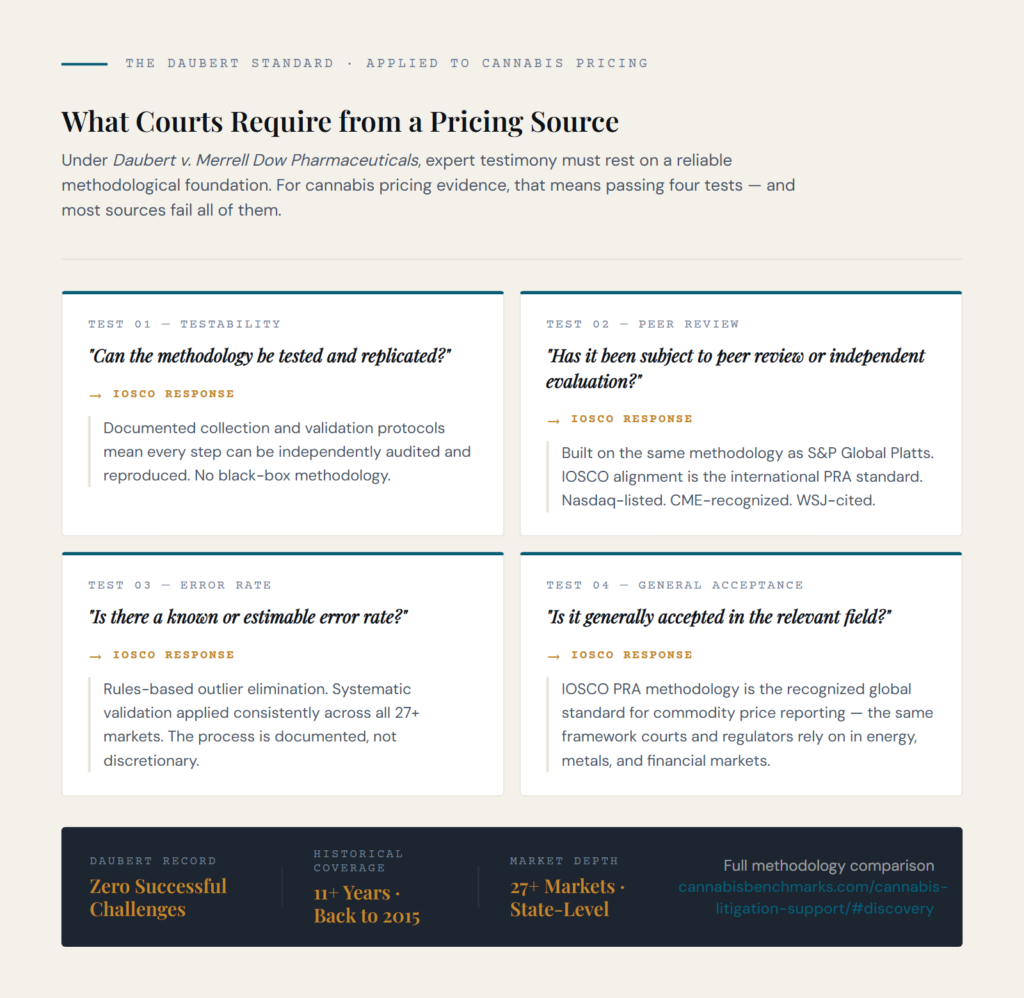
The Federal Rules of Evidence, as interpreted under Daubert v. Merrell Dow Pharmaceuticals and its progeny, require that expert testimony rest on a reliable foundation. For a pricing source, that means courts apply a methodological test — not a credibility test.
The questions a court will ask about any pricing source used to anchor an expert opinion:
For cannabis pricing, those abstract questions become concrete ones: Was the data independently sourced — or self-reported by parties with a stake in the result? Is the collection methodology documented? Can it be audited? Has it been recognized by a body with no financial interest in the outcome?
Most cannabis pricing sources cannot answer yes to any of these questions. That isn’t always a question of integrity. It’s a question of design. Market reporting and evidentiary standards require very different things from a data source.
Visit the NLDS Litigation Support Desk
Blended invoice averages. These are the most commonly used cannabis pricing inputs in litigation. They are also the most routinely challenged. The fundamental problem: the data is self-reported by the parties involved in the transactions being priced. Selection bias is inherent — operators submit the invoices they have available, not a representative sample. There is no independent verification, no systematic outlier elimination, no audit trail. When opposing counsel asks how the average was constructed and who validated it, there is no defensible answer.
Broker price quotes. A broker quote is an expression of willingness to transact at a particular moment, in a particular relationship. It is not a transaction-based price. It reflects the broker’s position, the dynamics between the specific parties, and market conditions at that instant. Non-arm’s-length by construction. Courts have been clear that non-arm’s-length pricing is not a reliable basis for market valuation.
Trade publication estimates. Cannabis trade publications serve market participants who need directional pricing information for business decisions. That is a legitimate function — but it is a different function than providing evidence. The collection protocols behind most trade publication pricing are undocumented. The methodology has not been peer reviewed. There is no IOSCO or equivalent standard applied to how prices are gathered, weighted, and reported. If challenged on methodology, there is nothing to point to.
Operator-submitted surveys. The evidentiary problem here is structural and visible. Asking cannabis operators to self-report pricing data for proceedings in which their financial interests are directly implicated creates an obvious motivation to misrepresent. Courts recognize this. So does opposing counsel.
A pricing source that survives Daubert has specific properties at the methodology level — not the brand level.
The price reporting agency (PRA) standard, as codified by the International Organization of Securities Commissions (IOSCO), establishes exactly those requirements. IOSCO-aligned methodology means collection protocols are documented and auditable, outlier elimination is systematic and rules-based, pricing is transaction-based rather than survey-based, and the methodology can be independently verified by a third party with no stake in the result.
It is the same standard applied by S&P Global Platts for energy and commodity markets. It exists precisely because those markets also operate in adversarial settings — regulatory proceedings, contract disputes, litigation — where the pricing source will be challenged.
Cannabis Benchmarks® is built on this methodology. The data is independently sourced. The collection and validation protocols are documented. The benchmarks are Nasdaq-listed and CME-recognized. They’ve been cited by the Wall Street Journal. The methodology has been applied consistently since 2015, across 27+ markets with state-level and grow-type-specific granularity.
Across every engagement where Cannabis Benchmarks® data has been used as the pricing basis — damages claims, expert witness testimony, IRS proceedings, and arbitration — there have been zero successful Daubert challenges.
That is a track record, not a promise. It reflects what happens when the underlying data source was built for the environment in which it is used.
The practical implication is straightforward: the pricing source you identify early in a cannabis matter becomes the foundation you’ll defend at every subsequent stage. If it was built for market reporting rather than evidentiary standards, the gap will surface — typically at the moment that costs the most to address.
When evaluating any cannabis pricing source for use in litigation or expert testimony, the methodology questions to ask are:
The comparison between what commonly fails and what survives is available in detail at our discovery page:
→ View the methodology comparison
If you’re working a cannabis or hemp pricing matter and want to understand what the data looks like for your specific situation, we’re available for a direct conversation.
Cannabis Benchmarks® is published by New Leaf Data Services, LLC — an independent price reporting agency with 11+ years of wholesale pricing data across 27+ U.S. cannabis markets. IOSCO-aligned. Nasdaq-listed. CME-recognized.